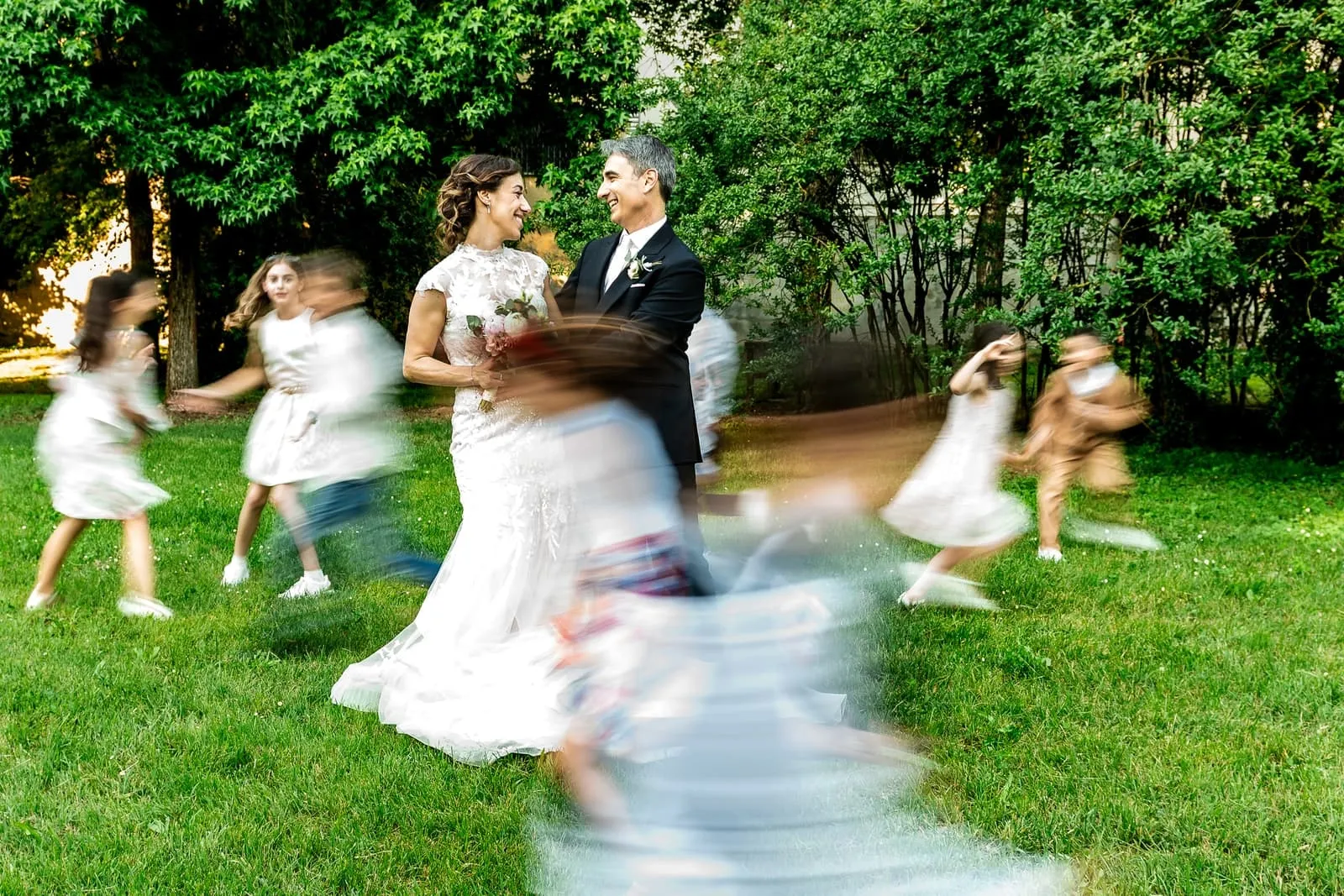
A photograph can make you stop on a website. Choosing who will document your wedding means understanding what surrounds that image: how the day is followed, how much space people are given and how photography and film fit together.
Start with the style, then ask practical questions. These are not about finding the best professional in absolute terms. They help you find the right person for your day.
Look for continuity beyond the standout images
Ask to see complete stories when they are available and can be shared. Notice how the pictures change between preparations, ceremony and party, how people are represented and which events receive attention.
A portfolio is necessarily selective. A fuller sequence helps you decide whether the quieter passages feel right to you as well. For film, ask for examples relevant to the proposed service. A word such as “cinematic” cannot replace material you can actually watch and a discussion about the intended result.
Establish what spontaneity means to you
“Documentary” does not automatically mean no guidance at all. You might want discreet coverage alongside a few couple portraits and photographs with the people closest to you.
Ask how these needs are handled. Will the party be interrupted frequently? How will family photographs be organised? Where do portraits fit? If being photographed makes you uncomfortable, discussing that beforehand is more useful than trying to learn poses.
In my approach, documentary coverage and gentle guidance can coexist. The day remains yours rather than becoming a continuous photoshoot.
Photography and film: agree who covers what
A coordinated story needs clear operational decisions. Who will be there? Which events will be photographed, filmed or covered in both ways? How will simultaneous events in different places be managed?
I am Simone, the principal photographer and filmmaker. I work personally in both media with a consistent creative direction. The team and any additional professionals are agreed around the coverage required. One person cannot guarantee every simultaneous viewpoint.
The Photography & Films page explains this connection. The individual photography and film pages help distinguish the service itself from the examples available to view.
Compare proposals with the same scope
Before comparing totals, check what each proposal is designed to cover. Locations, events, staffing and final work may differ. Ask about selection, postproduction and delivery, referring to what is actually being agreed.
Do not assume that particular quantities, film lengths, revisions or additional services are included unless stated. Asking about a budget range is entirely reasonable: an initial indication can help you decide whether to explore further, without having to arrange a consultation simply to obtain basic information.
Keep a simple comparison sheet
For each proposal, note the main contact, coverage, team, expected deliverables and exclusions. Leave a column for anything that needs clarification. Missing information should not be interpreted as an included service.
If your question concerns photographic style, explore documentary and traditional wedding photography. For the organisation of photography and film, read what changes with two hybrid operators.
Consider your relationship with the person
A conversation is also a chance to notice how you feel discussing your plans. Are your priorities heard? Do the answers resolve practical questions? Is it clear who your contact will be and how changes to the schedule will be shared?
You do not need a perfect list. Bring a few images that speak to you and explain why: the people, light, movement or closeness. That can communicate more than a long list of style labels.
Questions for your first conversation
- Can we explore a complete story, subject to the permissions available?
- How do portraits fit into the day?
- Who will photograph and film the proposed coverage?
- How will distant locations or simultaneous events be handled?
- Which deliverables and delivery arrangements are included?
Explore the photography portfolio and, if you would like to understand how we could work together, tell me your date and priorities. You can ask for information before deciding how to proceed.