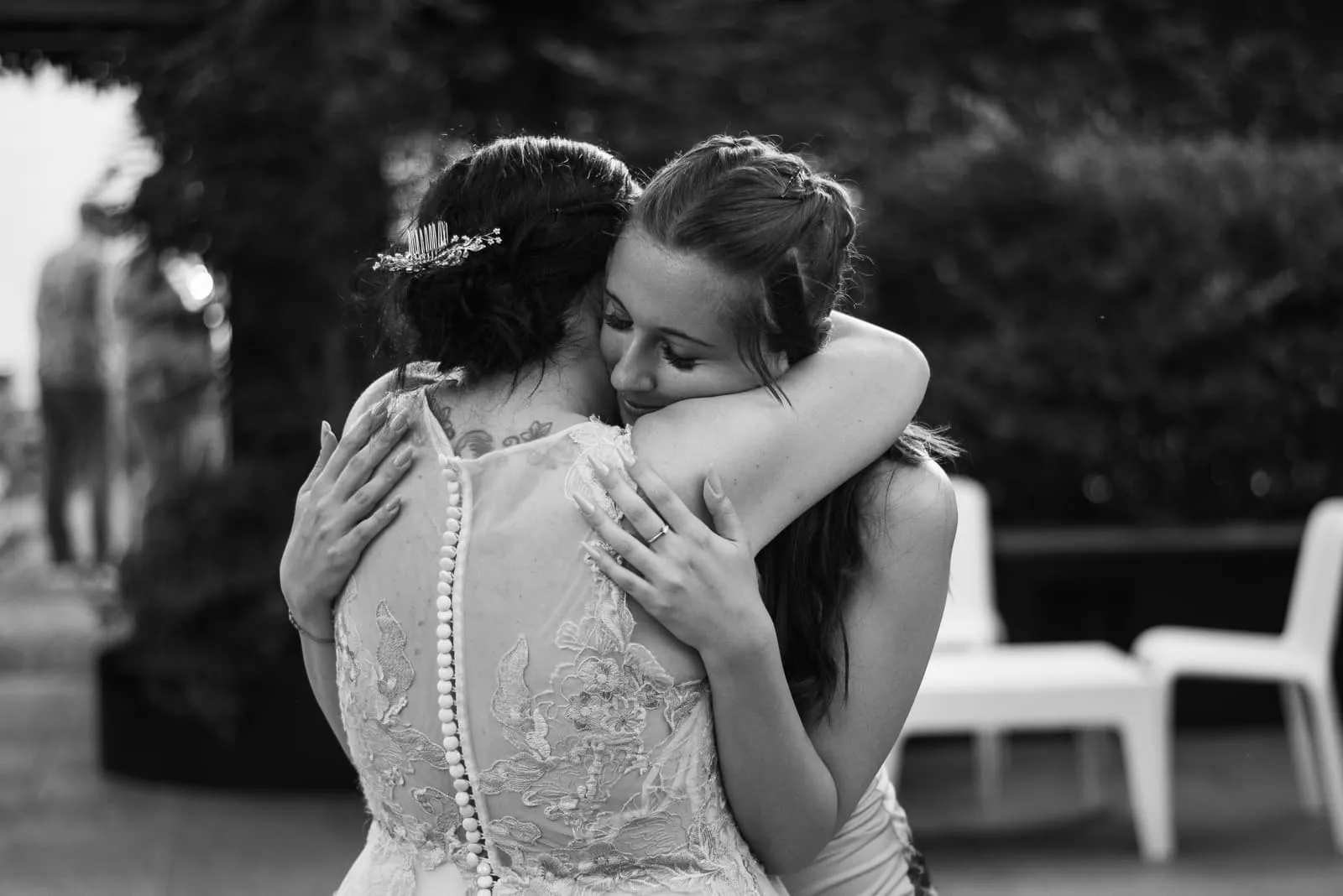
Wanting spontaneous photographs and a few portraits with your family is not a contradiction. Choosing documentary wedding photography does not mean giving up portraits. It means deciding how to include them without directing the entire day.
The difference between documentary and traditional wedding photography is mainly how the photographer participates in the wedding. It is not a competition between a modern approach and an outdated one, but a choice about experience, timing and visual language.
What is documentary wedding photography?
In documentary coverage, the photographer observes what happens and builds a story through gestures, relationships, details and events that are not repeated for the camera.
It might be someone adjusting a dress, a hand reaching for another before the ceremony, or laughter between friends at the reception. These can be small scenes, but they show how the day was actually experienced.
The aim is not to take pictures at random or remain hidden throughout. Documentary photography calls for attention, anticipation, composition and sensitivity to light. Even without intervening, the photographer makes many decisions.
What do we mean by traditional wedding photography?
“Traditional” often describes a more guided service: the photographer organises some scenes, suggests poses, arranges people and creates images with greater control.
This may suit couples who want formal portraits, carefully arranged group photographs or a classic representation of the day.
Labels have limits, though. A posed photograph can feel natural and elegant, and documentary work can be visually considered. Neither term alone guarantees the quality of the result.
The practical difference is the time you spend on photographs
Imagine the period after the ceremony.
With a strongly guided approach, the photographer may suggest a sequence of photographs in different positions and locations. This offers more control over the result but requires dedicated time.
With a documentary approach, a couple may choose a shorter portrait session and leave more time for the reception, guests and events as they unfold. That does not mean every portrait is improvised. It means choosing a few deliberate interventions rather than directing the whole day.
The question is how much time you want to spend in front of the camera, and how much you want to enjoy without interruption.
Does documentary mean no posing? No
Photographs with parents, grandparents, witnesses and friends matter. Some become more valuable over time, regardless of visual trends.
It helps to distinguish three elements:
- The unfolding story: preparations, ceremony, embraces, speeches and party.
- Couple portraits: an agreed period, with gentle guidance where useful.
- Family photographs: a short, organised list so that important people are not overlooked.
These can coexist. Documentary photography should not become a rigid principle that prevents a couple from having a photograph they want.
What if we feel awkward in front of a camera?
If you do not know where to put your hands, how to look at each other or what expression to make when you feel watched, tell the photographer before the wedding. You do not need to arrive knowing how to pose.
An unobtrusive approach can help by reducing time spent performing a pose. For portraits, instead of asking for unnatural gestures, the photographer can choose good light and let you move and interact, offering a few useful pointers.
Discretion should not be confused with a lack of guidance. A good photographer knows when to step back and when to help.
Does documentary photography have a fixed look?
No. Documentary describes a way of telling a story. It does not require muted colours, black and white, strong contrast or a particular skin tone.
Documentary work can be bright, cinematic, restrained or more intense. That is why it helps to see complete galleries, rather than only social media selections. Look for consistency across preparations, ceremony, outdoor portraits and the evening party.
Ask whether the people and atmosphere feel recognisable, whether the light feels believable and whether you can imagine enjoying that style when you look back in years to come.
Does it also affect the wedding film?
Yes. Film can also follow a documentary approach. A film built around real events, sounds and shared experiences has a different character from one relying mainly on staged sequences.
Photography and film should work together rather than obstruct each other. When both matter to you, discuss beforehand who will film and how the same events will be covered.
With Metodo Unico®, Jessica and I work as two operators with photography and video skills. This allows us to create a coordinated story from different viewpoints, without promising that every instant can be documented simultaneously in both formats.
Explore our wedding photography and wedding film service for more detail.
How to decide which approach suits you
Ask yourselves three questions:
- Do we want to spend substantial time on guided photographs, or enjoy the day with fewer interruptions?
- Which images are essential to us? Portraits, family, spontaneous events, details or the party?
- Does the portfolio we are looking at show how a whole wedding is documented?
There is no answer that suits everyone. Some couples choose mainly documentary coverage with a short portrait session; others want more photographic direction. What matters is knowing this beforehand.
Look through the portfolio with a specific question
In the photography portfolio, look for relationships as well as portraits. Ask which images feel like you and which would make you uncomfortable. Bringing two or three examples to a conversation helps turn “spontaneous” into practical preferences.
To assess attendance, coverage and delivery too, continue with the guide to choosing a photographer and videographer.
The photographs should feel like you
A wedding should not be organised solely around images. Photographs should preserve its meaning rather than take the place of the experience.
For me, documentary photography is above all a way of paying attention: giving people space and offering guidance when it will genuinely help a photograph. Without rigid rules or endless posing, and without giving up the portraits that matter.
If that approach feels right, tell me about your wedding. We can discuss the balance of documentary coverage, portraits and film that suits your day.